

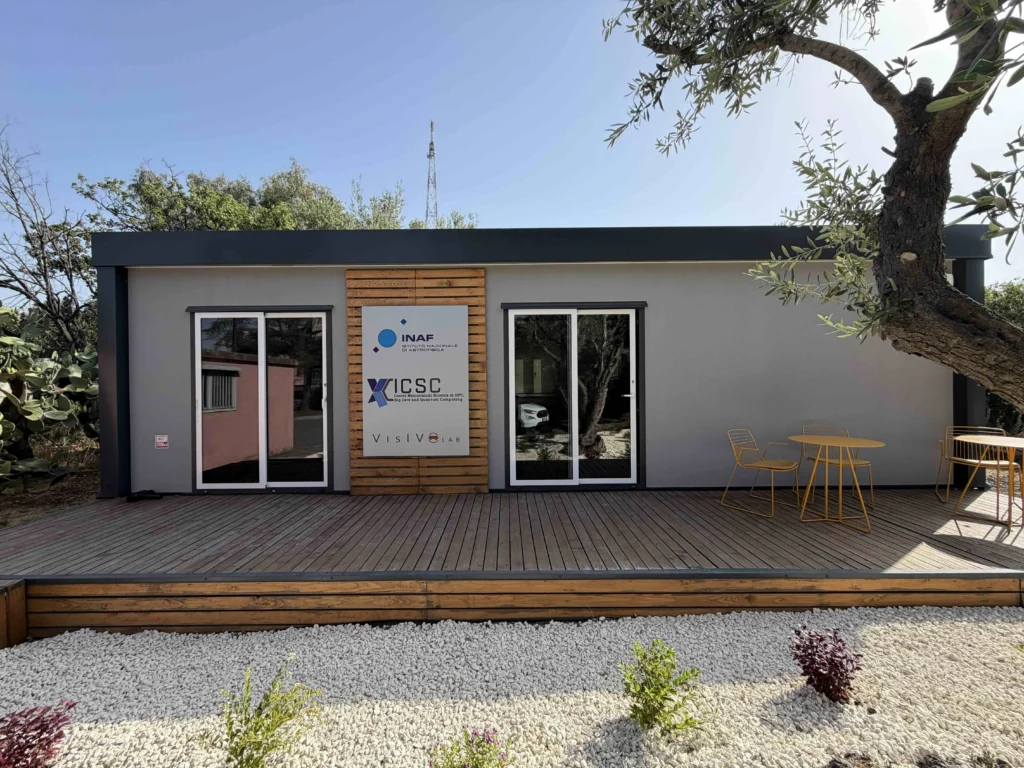
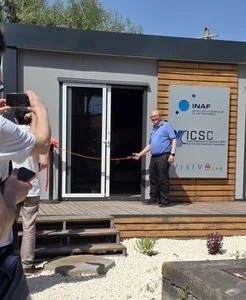
VisIVOLab was officially inaugurated on Tuesday 14 July 2026 at the INAF – Osservatorio Astrofisico di Catania. The new Scientific Visualization Laboratory, co-funded by INAF and by the ICSC National Research Centre in High Performance Computing, Big Data and Quantum Computing, opened its doors during the one-day workshop “INAF verso il Centro Nazionale HPC 2.0”, which brought together researchers, technologists and institutional partners to review what INAF has achieved within ICSC and to look at what comes next after the PNRR phase.
The ceremony was attended by the President of the ICSC National Centre, Antonio Zoccoli, by the Director of the Catania Observatory, Maria Elisabetta Palumbo, and by representatives of INAF’s Scientific Directorate.
From Spoke 3 to a permanent laboratory
Much of the day was devoted to the results of ICSC Spoke 3 “Astrophysics and Cosmos Observations”, coordinated by INAF, where astrophysics meets supercomputing, large-scale data analysis, machine learning and digital twins. A central example was HaMMon – Hazard Mapping and Vulnerability Monitoring, which showed that visualization and data-analysis tools born for astrophysical research can be transferred to natural-hazard monitoring and territorial vulnerability assessment with a direct social impact.
VisIVOLab grows out of that experience. The laboratory is a permanent infrastructure for immersive scientific visualization, virtual reality, high-performance computing, artificial intelligence and digital twins. It allows researchers to step inside the outputs of large numerical simulations, observational datasets and complex 3D models, and it offers the same capabilities to science communication, industrial applications and post-event analysis of landslides and other catastrophic events.
What comes next
The opening marks both the completion of a path started within ICSC and the beginning of a new phase of exploitation. INAF will play a role in the Centre’s forthcoming initiatives, in particular ECHO-TWIN, dedicated to digital-twin-enabled smart ecosystems across the Edge–Cloud–HPC continuum. The laboratory’s ambition is to carry the solutions developed during the PNRR phase towards industry and public administration, and to become a national reference point for advanced scientific visualization and for the combined use of VR, AI and supercomputing on scientific and socio-economic challenges.